Location Fundamentals: Connecting Global Markets via Egypt's Core Backbone
Geographic Strategic Advantage & Time Zone Alignment
Egypt's geographic location is a massive strategic advantage for businesses. Serving as a natural global crossroads connecting Europe, Asia, and Africa, Egypt is as a prime gateway for international trade and real-time corporate services.
Egypt utilizes its strategic Eastern European Time (EET) zone alignment to enable flawless
Follow-the-Sun business continuity between the Americas, EMEA, and Asia-Pacific operations. This ideal positioning ensures seamless business continuity and real-time collaborative workflows for global delivery centers in Egypt to hand off or absorb workflows seamlessly from other global regions.
Furthermore, Egypt provides a
cosmopolitan outlook built upon a rich multicultural history, yielding a highly adaptable and culturally open workforce suited to global corporate cultures.
Egypt: The Digital Gateway Connecting East and West
Global Internet Backbone Node
Global Internet Backbone Node and Strategic Chokepoint: Over 90% of data flow between Asia and Europe traverses
Egypt's network of 21 subsea cables and meshed land routes, representing approximately 17% of global data traffic.
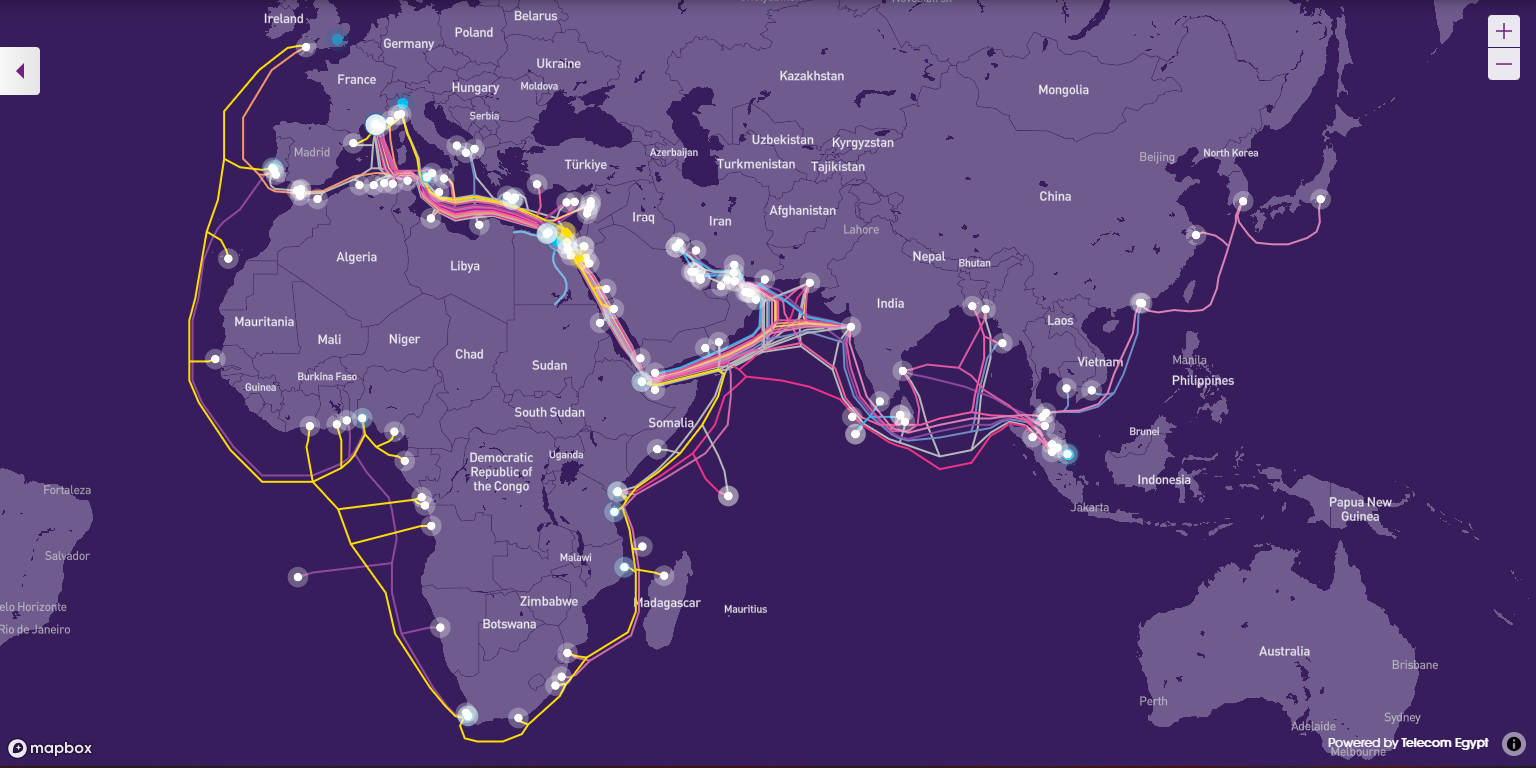
Figure 1 - Telecom Egypt Digital Hub: Interactive network map showing 10+ mesh terrestrial crossing routes connecting Mediterranean cable landing stations (Alexandria, Abu Talat, Sidi Kerir, Port Said) to Red Sea landing stations (Suez, Zafarana, Ras Ghareb)
High Redundancy: Bridges transcontinental traffic using 11 landing stations on the Red Sea and Mediterranean, up from 6 in 2018. The total number of international data routes crossing Egypt has doubled to 11 routes.
Targeted Telecom Investment
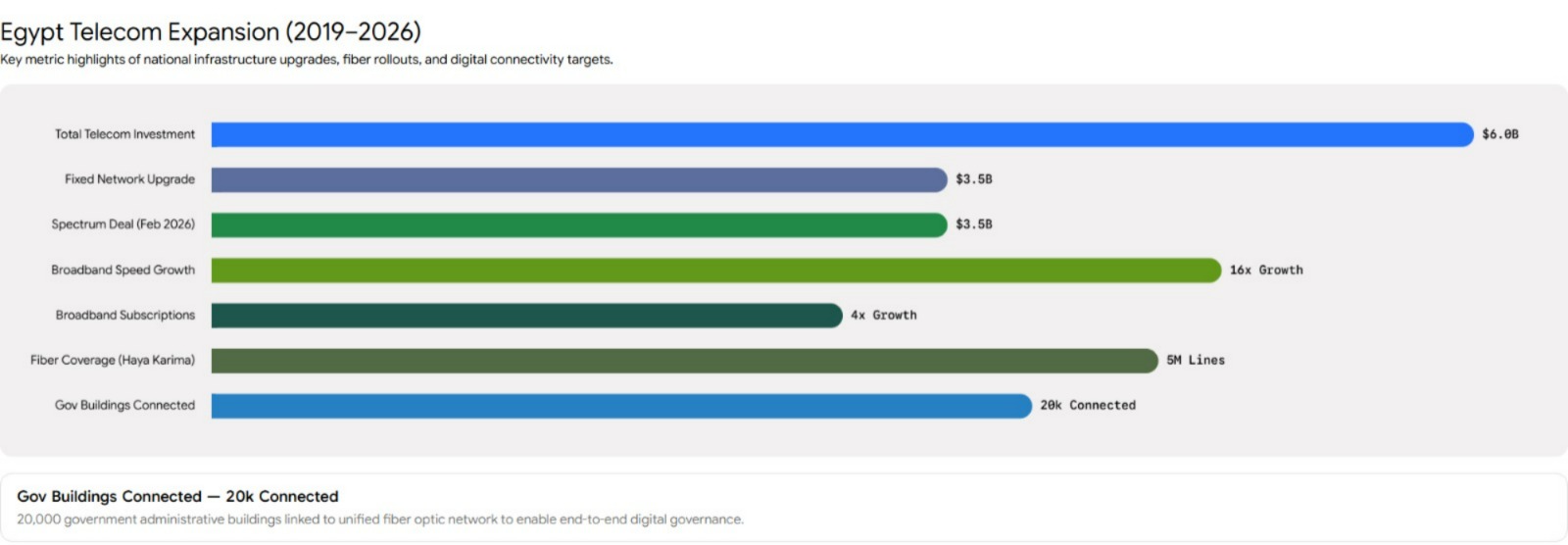
Digital Infrastructure Evolution: Deployed over $6 billion since 2019 to completely overhaul fixed and mobile broadband networks nationwide; including $3.5 billion to upgrade fixed networks and replace legacy copper lines, doubling the national fiber-optic network to 6,000 km since 2021. The fixed broadband speed has grown 16-fold between 2017 and 2025, while broadband subscriptions have quadrupled.
Widespread Rural Rollout: Extended high-speed infrastructure via the Decent Life (Haya Karima) initiative, deploying 5 million fiber-optic lines across more than 1,250 villages. The service has been connected to 75% of service complexes in targeted villages, and approximately 20,000 government buildings have been linked to the fiber-optic network.
Spectrum Expansion: Finalized a landmark $3.5 billion deal in February 2026, releasing 410 MHz of frequency bands to the four major operators to accelerate advanced network capabilities. This is equivalent to the total spectrum assigned since the launch of mobile services in Egypt, representing the largest spectrum agreement in the country's history.
Network Performance & Speed
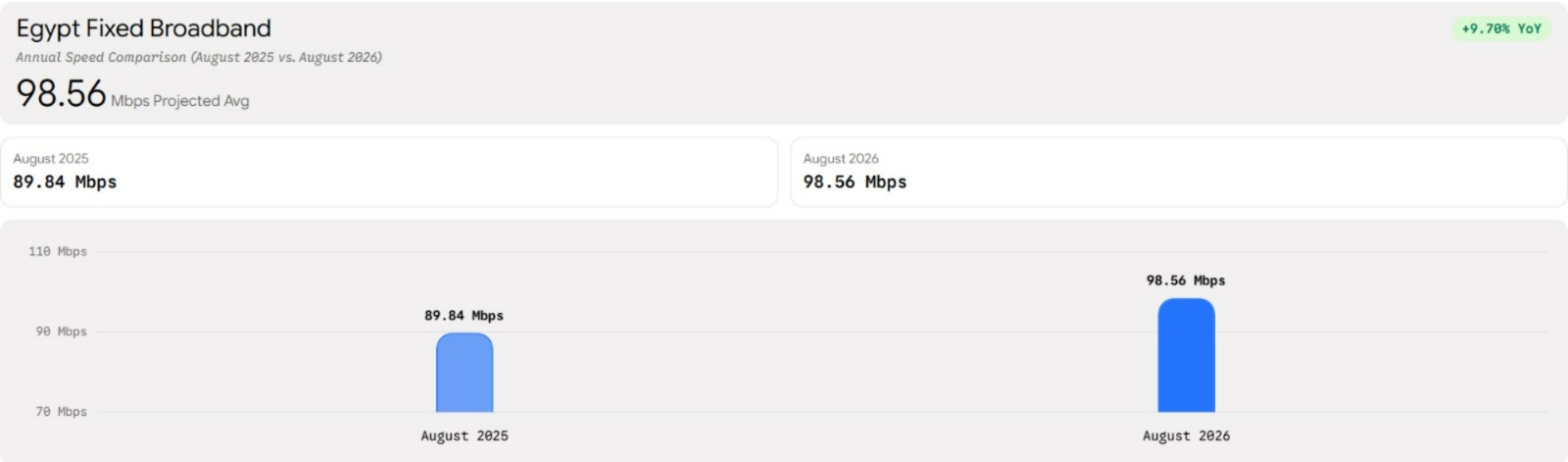
Africa's #1 Speed: Ranks first on the continent for fixed broadband, securing reliable throughput for global engineering hubs.
Consistent Growth: Median fixed internet speeds rose to 98.56 Mbps in August 2026, up from 89.84 Mbps in the same period of 2025—a year-over-year increase of 9.70%. This represents a historic high for Egypt's fixed broadband performance.
World-Class Infrastructure & Strategic Ecosystems
Physical & Transport Infrastructure
|
Physical Asset / Highway Corridor |
Strategic Impact & Key Metric |
|
Global Road Quality Index |
Jumped 100 ranks to
18th worldwide over the past decade. |
|
Regional Ring Road & Arterials |
Directly connects industrial hubs to commercial centers & bypasses congestion. |
|
Smart Electric Transit (LRT & Monorail) |
Connects East and West Greater Cairo with eco-friendly transit. |
|
Dual-Airport Infrastructure |
Strategic international airports flanking both sides of Cairo for air access. |
Table 1 - Egypt Physical Transit & Logistics Network Performance Metrics
Advanced Road Network: Egypt has risen 100 places over the past decade to rank 18th globally in road quality, supporting efficient nationwide mobility.
Seamless Connectivity: Major highway networks, including the
Regional Ring Road, link industrial zones to key business districts, while new bridge corridors ease congestion and improve cross-city access.
Modern Mass Transit: Expanding electric rail and monorail systems provide fast, reliable, and traffic-free mobility across Greater Cairo's eastern and western zones.
Dual-Airport Access: International airports on both sides of Cairo ensure efficient global connectivity and seamless access to commercial hubs.
Business & Enterprise Ecosystem
|
Asset Category |
Strategic Features & Location Clusters |
|
Premier Business Parks |
High-end corporate hubs located in New Cairo, West Cairo, & New Capital. |
|
Tier-2 Tech Parks Network |
Specialized tech ecosystems in Cairo & secondary governorates. |
|
Special Economic Zones (SEZs) |
Streamlined entry, tax incentives, & legislative protections. |
Table 2 - Key Real Estate and Infrastructure Assets for Business Expansion in Egypt
Premier Business Parks: The office market in Egypt is undergoing a major revolution, shifting toward state-of-the-art business environments that redefine the modern workplace. Egypt hosts several premier business parks and tech hubs concentrated around Greater Cairo, West Cairo, New Cairo, and the New Capital. These developments offer modern corporate offices, administrative spaces, and mixed-use retail amenities.
Tech Parks: A growing network of technology parks across Cairo and tier-2 cities offers advanced digital infrastructure for global service delivery and high-value operations.
Special Economic Zones: Dedicated zones provide competitive incentives, strong legal frameworks, and streamlined processes that accelerate market entry and business expansion.
LINK
Global Market Access & Trade Treaties
Establishing an operational footprint in Egypt opens unmitigated access to regional and global consumer bases. Egypt is backed by robust
Free Trade Agreements covering
70+ countries across Africa, Asia, and Europe, enabling duty-free movement of high-tech hardware, electronic assemblies, and digital services.
|
Regional Framework |
Geographic Scope & Key Advantages |
|
AfCFTA |
Unifies 1.3+ billion African consumers; eliminates 90% of tariffs. |
|
COMESA |
Preferential duty-free trade across 21 East & Southern African nations. |
|
GAFTA |
Duty-free commercial trade covering 18 Arab nations (~400M consumers). |
|
Egypt–EU Partnership |
Tariff-free industrial goods & preferential tech service trade across 27 EU states. |
|
QIZ Agreement |
Duty-free access to US markets for qualified manufactured goods. |
|
WTO & GATS Signatory |
Full non-discriminatory legal protection for foreign digital exporters. |
Table 3 - Egypt Trade Infrastructure: Regional Frameworks, Market Access, and Duty-Free Scope
Regional & Pan-African Treaties
African Continental Free Trade Area (AfCFTA): Connects Egypt to a unified pan-African market of 1.3+ billion people, eliminating tariffs on 90% of goods and facilitating cross-border digital service delivery.
Common Market for Eastern and Southern Africa (COMESA): Provides preferential duty-free trade access across 21-member states in East and Southern Africa.
Greater Arab Free Trade Area (GAFTA): Facilitates duty-free trade and streamlined commercial customs across 18 Arab countries, covering approximately 400 million consumers.
Euro-Mediterranean & European Treaties
Egypt–EU Association Agreement: Grants duty-free tariff access for industrial goods and provides preferential frameworks for agricultural and tech service trade between Egypt and all 27 European Union member states.
EFTA–Egypt Free Trade Agreement: Establishes preferential trade relations with the European Free Trade Association nations (Iceland, Liechtenstein, Norway, and Switzerland).
UK–Egypt Association Agreement: Secures tariff-free bilateral trade and service continuity with the United Kingdom post-Brexit.
Americas & Interregional Treaties
Mercosur–Egypt Free Trade Agreement: Opens preferential tariff schedules and market access across major South American economies (Argentina, Brazil, Paraguay, and Uruguay).
Qualifying Industrial Zones (QIZ): Allows duty-free entry into the United States for manufactured goods and assemblies produced in designated Egyptian industrial areas meeting regional origin criteria.
World Trade Organization (WTO) Framework
WTO Member & GATS Signatory: Egypt maintains full membership in the World Trade Organization (WTO) and adheres to the
General Agreement on Trade in Services (GATS), securing non-discriminatory treatment, legal predictability, and intellectual property protections for foreign digital service exporters.
Frequently Asked Questions
What are the primary technology parks operating in Egypt?
Egypt features several specialized tech zones designed for IT, BPO, and innovation. Key locations include:
·
Maadi Technology Park (Cairo): Dedicated investment zone specializing in call centers and IT outsourcing services.
·
Borg El Arab (Alexandria): Regional tech hub serving northern Egypt.
·
New Assiut & New Beni Suef: Technology parks supporting Upper Egypt's expanding digital ecosystem.
·
Sadat City (Menofia): Designed to serve the Nile Delta's industrial and technical sector.
·
New Administrative Capital & New Aswan: Advanced digital zones currently under development.
What incentives do technological parks in Egypt offer foreign IT and outsourcing companies?
Technology parks in Egypt provide competitive operational advantages, including tax incentives, stream-lined business registration under investment zone frameworks, advanced fiber-optic telecommunications infrastructure, and access to a highly skilled, multilingual talent pool at competitive operational costs.
Why is Egypt considered a leading global destination for IT outsourcing?
Egypt offers a strategic geographic location connecting Europe, Africa, and the Middle East, coupled with a large workforce graduating over 50,000 IT-related professionals annually. Its competitive labor costs, strong government backing through digital transformation initiatives, and robust international connectivity make it a top global offshoring hub.
Egypt: Direct Access to 70+ Global Markets
Egypt connects regional supply chains across Europe, the Middle East, and Africa. Supported by subsea fiber infrastructure, active trade agreements, and an annual pipeline of technical graduates, operations based in Egypt scale efficiently.
Whether you need an outsourcing base, a regional IT support hub, or a manufacturing assembly point, Egypt delivers the physical and digital infrastructure required to reach global end markets.
Contact our investment team to discuss operational requirements and site selection.

